
Is medication adherence a challenge in your
patients with Bacterial Vaginosis (BV)?
Now with NUVESSA,
BV dosing can be...

a In a clinical study, NUVESSA demonstrated statistically significantly higher cure rates of a Control Gel.1
Help your patients adhere to BV treatment2 with NUVESSA—
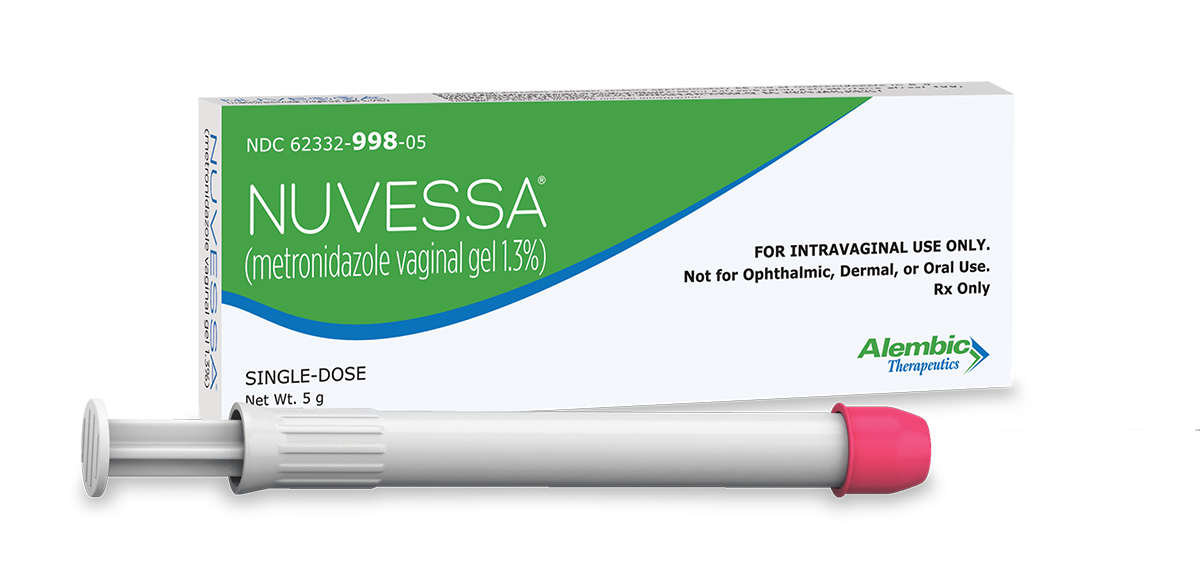
The one and only single-dose intravaginal metronidazole gel treatment for BV
NUVESSA is a prescription medicine used to treat bacterial vaginal infections in females 12 years of age and older. It is not known if NUVESSA is safe and effective in female children younger than 12 years of age.1
a Single-dose NUVESSA is administered once intravaginally.1
Savings Program
Eligible patients may pay as little as $25b for their prescription
b The patient is responsible for the first $25 of their co-pay and cash-paying patients should pay approximately $55. For cash-paying patients or insured patients when NUVESSA is not covered by primary insurance, patients may still use this savings card but may have an outstanding balance. Please see Program Terms, Conditions, and Eligibility Criteria on savings card.
Please see Program Terms, Conditions, and Eligibility Criteria on savings card.

Help your patient adhere to BV treatment2 with NUVESSA — the one and only single-dose intravaginal metronidazole gel for BV
- In a clinical study, a single dose of 1.3% metronidazole vaginal gel (MVG) demonstrated comparable efficacy to a 5-dose regimen of 0.75% MVG3,c
- 1 pre-filled applicator offers ease of use at bedtime1
- 1 targeted dose at the site of infection minimizes unnecessary drug exposure4

Please see Program Terms, Conditions, and Eligibility Criteria on back of card or here.
c In a phase 2, randomized, controlled, investigator-blinded, dose-ranging study, women with BV (N=255) were treated with different metronidazole-based regimens. The primary endpoint was therapeutic cure (defined as clinical plus bacteriologic cure) at Day 21. A 1-time dose of MVG 1.3% at bedtime was equal in terms of safety, efficacy, and tolerability. For detailed clinical data from NUVESSA studies, visit this link.
References: 1. Nuvessa prescribing information. 2. Bartley JB, et al. Sex Transm Dis. 2004;31(8):488-491. 3. Chavoustie SE, et al. J Low Genit Tract Dis. 2015;19(2):129-134. 4. Hirai J, et al. J Infect Chemother. 2025;31(11):102826.
INDICATION AND IMPORTANT SAFETY INFORMATION
INDICATION
NUVESSA (metronidazole vaginal gel 1.3%) is an intravaginal treatment indicated for the treatment of bacterial vaginosis in females 12 years of age and older.
IMPORTANT SAFETY INFORMATION
CONTRAINDICATIONS
NUVESSA is contraindicated in:
- Patients with a history of hypersensitivity to metronidazole, parabens, other ingredients of the formulation, or other nitroimidazole derivatives.
- Patients using disulfiram or within 2 weeks of disulfiram use.
- Patients using alcohol. Alcoholic preparations (e.g., ethanol, propylene glycol) and beverages should not be consumed during and for at least 24 hours after NUVESSA therapy.
WARNINGS and PRECAUTIONS
Central and Peripheral Nervous System Effects
Convulsive seizures, encephalopathy, aseptic meningitis, optic and peripheral neuropathy have been reported in patients treated with oral or intravenous metronidazole. NUVESSA should be administered with caution to patients with central nervous system diseases.
Discontinue promptly if abnormal neurologic signs development.
Carcinogenicity in Animals
Metronidazole has been shown to be carcinogenic at high doses administered orally in mice and rats. Unnecessary use of metronidazole should be avoided.
Drug/Laboratory Test Interactions
Metronidazole may interfere with certain serum chemistry values, such as aspartate aminotransferase (AST, SGOT), alanine aminotransferase (ALT, SGPT), lactate dehydrogenase (LDH), triglycerides, and glucose hexokinase. Values of zero may be observed.
Adverse Reactions
The most common adverse reactions (≥1%) observed in adult clinical studies were vulvovaginal candidiasis, headache, vulvovaginal pruritus, nausea, diarrhea, and dysmenorrhea.
The most common adverse reactions (≥1%) observed in pediatric clinical studies was vulvovaginal discomfort.
This is not a complete list of risks.
Please see full Prescribing Information for detailed information here.